Author: Dr. Adanze Nge Cynthia
Disclaimer: The views expressed in this article are intended to promote evidence-based public health dialogue. All epidemiological references are drawn from WHO reports, peer-reviewed literature, and verified global health data.
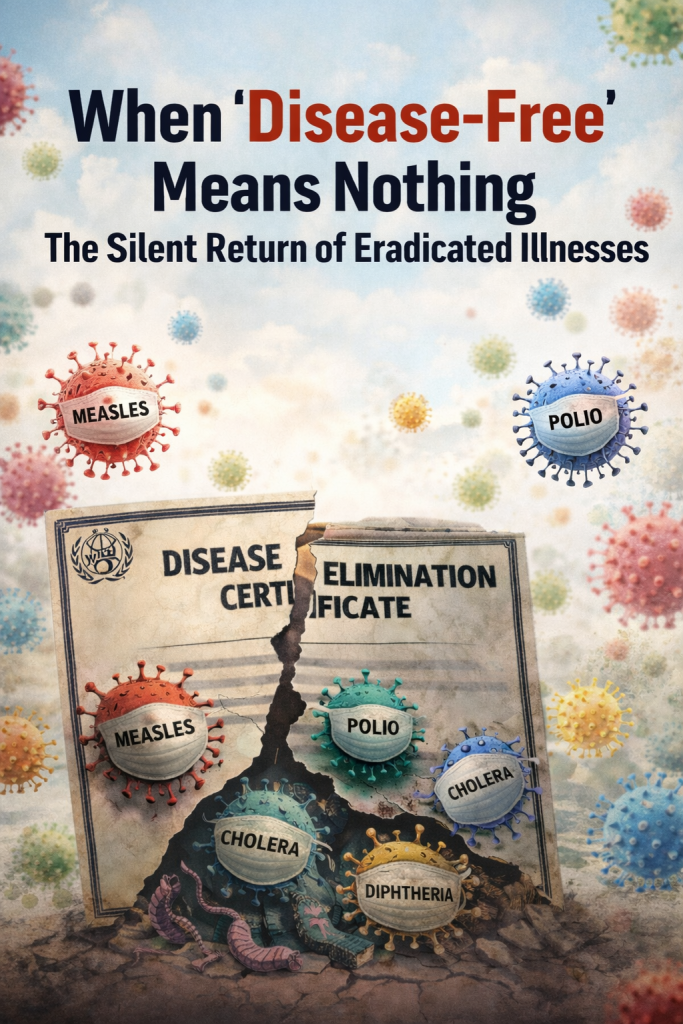
There is a certain comfort in a declaration of victory. When the World Health Organization (WHO) certifies a country as free from a particular disease, it signals decades of public health effort, mass vaccination campaigns, and improved sanitation infrastructure finally paying off. Governments celebrate. Headlines run. Funding shifts elsewhere. Then, quietly, the disease comes back.
Across the globe, a troubling pattern has emerged: measles returning to countries that had not seen a case in decades, polio surfacing in the wastewater of cities long considered immune, cholera tearing through communities that had celebrated its elimination, diphtheria reappearing in regions where it had been absent for generations, whooping cough spiking in nations with well-established immunisation programs, and dengue fever establishing local transmission in European countries that had never before recorded a home-grown case. These are not isolated incidents. These diseases, once declared eliminated, are staging strategic resurgences, slipping through the cracks of complacent health systems, vaccine-hesitant communities, and overstretched public health budgets. A certificate of disease elimination is not a permanent condition. It is a snapshot in time, and time, as we are learning, is unforgiving.
Some of the drivers of this global rollback are familiar. The COVID-19 pandemic disrupted routine immunisation programmes, leaving entire birth cohorts partially unvaccinated. Vaccine misinformation has eroded public trust where it was once near universal. Climate change is expanding the range of disease-carrying vectors. Perhaps most insidiously, institutional complacency, or the tendency to lessen surveillance once an illness appears “solved”, has resulted in perilous blind spots. Measles, polio, and cholera are three illnesses that clearly demonstrate this failing.
Measles: A Preventable Disease with No Excuse to Return
Measles is the most glaring example of a preventable disease that should, by all scientific reasoning, no longer circulate in the developed world. The United States (US) declared measles eliminated in 2000, a milestone built on decades of mass vaccination with the MMR vaccine. Yet by the close of 2025, the country had reported 2,256 confirmed cases across 45 jurisdictions, with 49 distinct outbreaks recorded, the highest case count since elimination was declared. Three deaths were confirmed, the first measles fatalities in the US in over a decade. Crucially, 82% of cases involved individuals who were unvaccinated or had unknown vaccination status.
In November 2025, the Pan African Health Organization (PAHO) announced that the Region of the Americas had lost its collective measles elimination status, with Canada officially declaring its own lost status following more than 12 months of endemic transmission, and ongoing outbreaks in Mexico further compounding the regional picture. The US’ individual elimination status remains under active CDC review, with analysts working to determine whether its outbreaks represent linked, continuous transmission, which would constitute loss of status, or separate imported introductions.
Either conclusion is damning. Vaccination coverage among US kindergartners dropped from 95.2% in 2019–2020 to 92.5% in 2024–2025, leaving an estimated 286,000 children below the 95% herd immunity threshold. Misinformation, particularly the long-debunked claim that the MMR vaccine causes autism, has been a significant driver. Writing in the New England Journal of Medicine, Anna Minta et al. (2023) note that since 2019, no WHO region has achieved and sustained measles elimination, with the COVID-19 pandemic having pushed global first-dose vaccine coverage to just 81%, the lowest level since 2008. Europe fared no better: 2024 saw the highest European measles case count in more than 25 years, accounting for 20% of total global cases.
Polio: Thought to Be on Its Last Legs, Yet Still Walking
Polio was one of the most feared diseases of the twentieth century. The global campaign to eliminate it ranks among the most ambitious in public health history, and by the mid-1990s, the Americas were certified polio-free. Wild poliovirus was driven to transmission in only a handful of countries, and total eradication seemed tantalizingly close. Then came the cracks.
In June 2022, a case of paralytic polio caused by circulating vaccine-derived poliovirus type 2 (cVDPV2) was identified in an unvaccinated adult in Rockland County, New York, the first US poliomyelitis case since 2013. The same genetically linked virus was simultaneously detected in London’s sewage and in wastewater samples in Jerusalem, Israel, linking outbreaks across three countries that each considered themselves polio-free. Emergency vaccination campaigns were launched in London for children under five, a public health mobilization the UK had not needed in decades.
The situation has only grown more complex. From January 2023 to June 2024 alone, 74 circulating vaccine-derived poliovirus outbreaks were detected across 39 countries, resulting in 672 confirmed paralytic cases. In Europe, vaccine-derived poliovirus type 2 was found in wastewater across 14 cities in five countries, Germany, Finland, Poland, Spain, and the UK, between September and December 2024, with sub-national vaccination coverage in some communities as low as 43%. As of early 2025, WHO’s International Health Regulations (IHR) Emergency Committee continued to classify international poliovirus spread as a Public Health Emergency of International Concern (PHEIC), a designation continuously renewed since 2014. The eradication finish line keeps moving, not because the science has failed, but because the political and logistical machinery required to sustain polio-free status has never been uniformly maintained.
Cholera: The Disease That Follows Collapse
Cholera is different from measles and polio in one important respect: it does not primarily depend on vaccine hesitancy to return. It depends on something arguably harder to fix: functioning clean water infrastructure and sanitation systems. When those collapse, cholera does not wait for an invitation.
In January 2023, WHO classified the global resurgence of cholera as a Grade 3 emergency, its highest internal level, reserved for crises requiring a comprehensive, organization-wide response. The scale of death has accelerated sharply: reported cholera deaths rose by 71% in 2023 compared to 2022, with over 4,000 people killed by a disease that is both preventable and easily treatable.
Recent cholera trends illustrate how fragile health and water systems continue to drive the persistence and resurgence of the disease in crisis-affected settings. Countries experiencing conflict and institutional instability have been particularly vulnerable. In Yemen, years of civil war have devastated health and water infrastructure, making the country one of the most severely affected. Similarly, cholera re-emerged in Syria and Lebanon after years of absence, largely due to the deterioration of water systems and conflict-induced displacement. Haiti, which had been moving toward cholera elimination, experienced renewed outbreaks in 2023 and 2024 as political instability and long-standing sanitation challenges undermined previous progress.
These country-level patterns reflect a broader global trend: by mid-2025, cholera transmission remained active in 32 countries across five WHO regions, with deaths in the first eight months of the year already exceeding the total recorded in 2024. Cholera’s resurgence sends a pointed message: disease elimination is not a biological achievement alone. It is a political and infrastructural one. A country can eliminate cholera and maintain that status for years, but the moment governance fails or conflict destroys water systems, the disease returns as though it never left. No WHO certificate changes that underlying fragility.
A Serious Policy Oversight That Can No Longer Be Ignored
This raises an issue that international health organisations have been hesitant to publicly address: is it right to permit nations to continue to be disease-free even when outbreaks reappear within their borders? A point-in-time evaluation forms the foundation of the present WHO certification scheme. When nations exhibit halted transmission and sufficient vaccination coverage, they are certified, and the world continues. However, what follows? Too often, the response is insufficient.
Countries that can retain disease-free status even after epidemiological conditions have changed create a dangerous gap between official classifications and realities on the ground. This has real consequences for how funding is allocated and how seriously governments take resurgence risk. A country that still holds disease-free status carries less political incentive to sound the alarm when early warning signs emerge. The label itself becomes a liability. Health policy must be an up-to-date, living and trustworthy document. The rise of vaccine hesitancy, pandemic disruptions, climate change, and increasing humanitarian crises all demand that elimination frameworks be regularly revisited and transparently enforced. Clinging to outdated certification while outbreaks unfold in real time is not a minor technical oversight; it is a breach of public health duty.
The Global Reckoning That Must Follow
For the WHO and allied global health bodies, the path forward requires honesty, rectitude, and transparency. It demands a robust, effective continuous post-certification monitoring and evaluation system, one that tracks not only whether a country once achieved elimination, but also whether conditions for maintaining it are still in place. It requires automatic review mechanisms when case counts cross defined thresholds, and the willingness to publicly flag when a country’s disease-free status is under threat, even when politically sensitive.
The global community must also be honest about the connection between geopolitical stability, economic inequality, and disease control. Cholera does not return to Yemen because Yemenis stopped caring about public health. Polio persists in marginalized communities not because parents refuse vaccination, but because the systems designed to reach them have failed. Measles spreads in wealthy nations because misinformation has been permitted to operate largely unchecked in the environments where vaccination decisions are made.
Conclusion
Declaring a country free of disease was always meant to be a milestone, not a finish line. The resurgence of measles, polio, and cholera in countries that were once held up as models of public health success is not just a warning, it is a verdict on what happens when the world mistakes a certificate for a cure. Global health organizations must now do what the science has always demanded: treat elimination not as an achievement to be celebrated and filed away, but as a standard to be actively defended, rigorously monitored, and honestly reassessed. The diseases never stopped looking for a way back. It is long past time our policies reflected that reality.